Polar Vortex
Dear Partners in Green,
I am writing this on Inauguration Day, the day Donald J. Trump will officially become the 47th President of the United States.
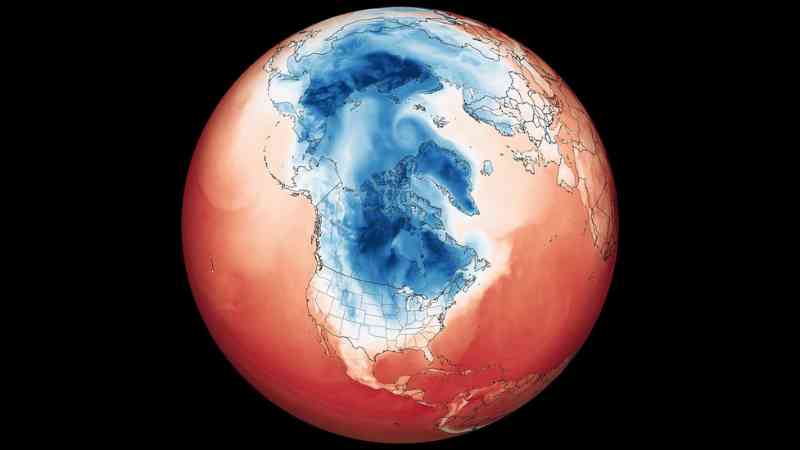
I am disheartened to know that so many of our fellow citizens voted for this person, but he won, and thus this is where we find ourselves on this day — this day in which much of our country is feeling the effects of a polar vortex. In today’s news, we are warned that life-threatening wind chills down to minus 55 °F are likely in the Plains and Upper Midwest, bringing the risk of hypothermia and frostbite for those exposed too long.
But this cold, dangerous and life-threatening system has much of the U.S. on alert as it makes its way across the nation, sending temperatures to unprecedented lows. Many, I am sure, will use this “event” to deny the reality of global warming. I am quite certain that our incoming president will be among them.
So, I decided to learn a bit more about this polar vortex:
A “polar vortex” is like a spinning circle of cold air around the North Pole, kept in place by strong winds; climate change can affect the vortex by making it weaker, which means sometimes that cold air can escape further south, bringing extreme cold snaps to places that aren’t used to it, even though the overall global temperature is rising; essentially the Arctic is warming faster than other areas, disrupting the normal balance of cold air at the poles, leading to occasional “polar vortex events” with colder weather further south.
Dr. Steven Decker, Director of the Meteorology Undergraduate Program at Rutgers, explains that climate change has resulted in more frequent polar vortex disruptions. He says that although temperatures are increasing on average, we still experience blasts of cold air due to recurring displacement of the vortex. It makes sense that the polar vortex tends not to be as strong due to global warming because the planet isn’t warming uniformly. It’s warming more at the pole, overall decreasing the strength of the polar vortex and the jet stream and making it more susceptible to being dislodged and sent our way.
For a more in-depth explanation you may visit the Environmental and Energy Study Institute (EESI) website.
We know that climate change is real, that denial of it is deadly, and that we are running out of time. We must be the voice of sanity in our speech and actions. We must keep the reality of climate change in the forefront — by writing green, speaking green, living green. I anticipate chaos in the next four years, but we cannot be distracted or fall into lethargy.
It is not the time to give up — just the opposite. It is time to dig in, to recommit, to speak out, and to unite.
Thank you for being on this most important journey.
Wishing peace and health to you and your loved ones.
Till next time,
Beth